
As Once Was…
So Is Now…
The History
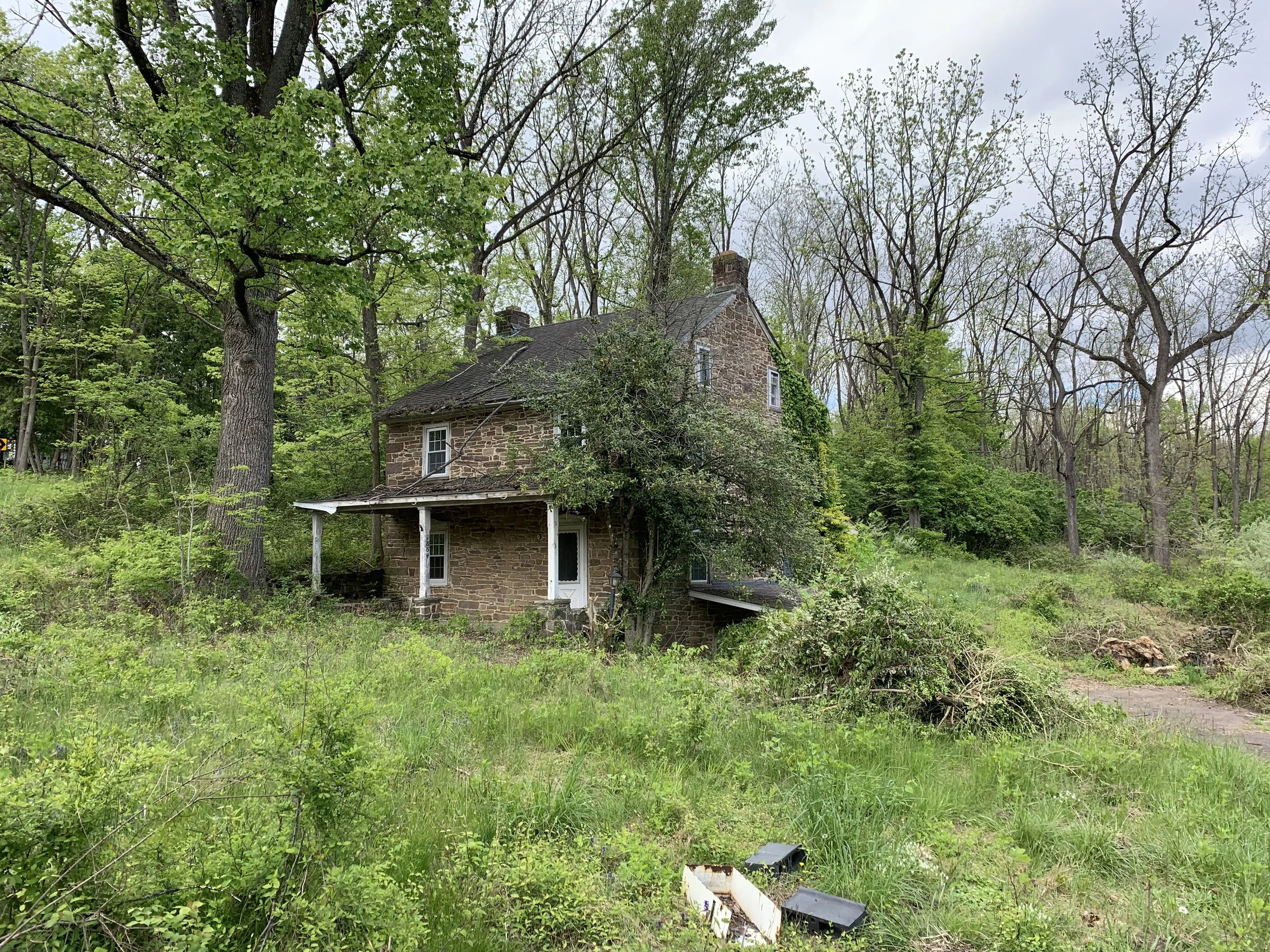
Upon acquiring the property in 2023, we had no knowledge regarding the age of the house or surrounding land. Little did we know that there was more than met the eye when it came to Conchordia.
One summer day in 2024, someone dropped off a photo copied piece of paper which was from a book later discovered as the “Worcester” book written by the Worcester Historical Society in 1976 for the bicentennial. The book tells the history of Worcester as well as showcases its historic homes and buildings.
This is what the paper read:
Mr. and Mrs. Charles Watkins Whitehall Road
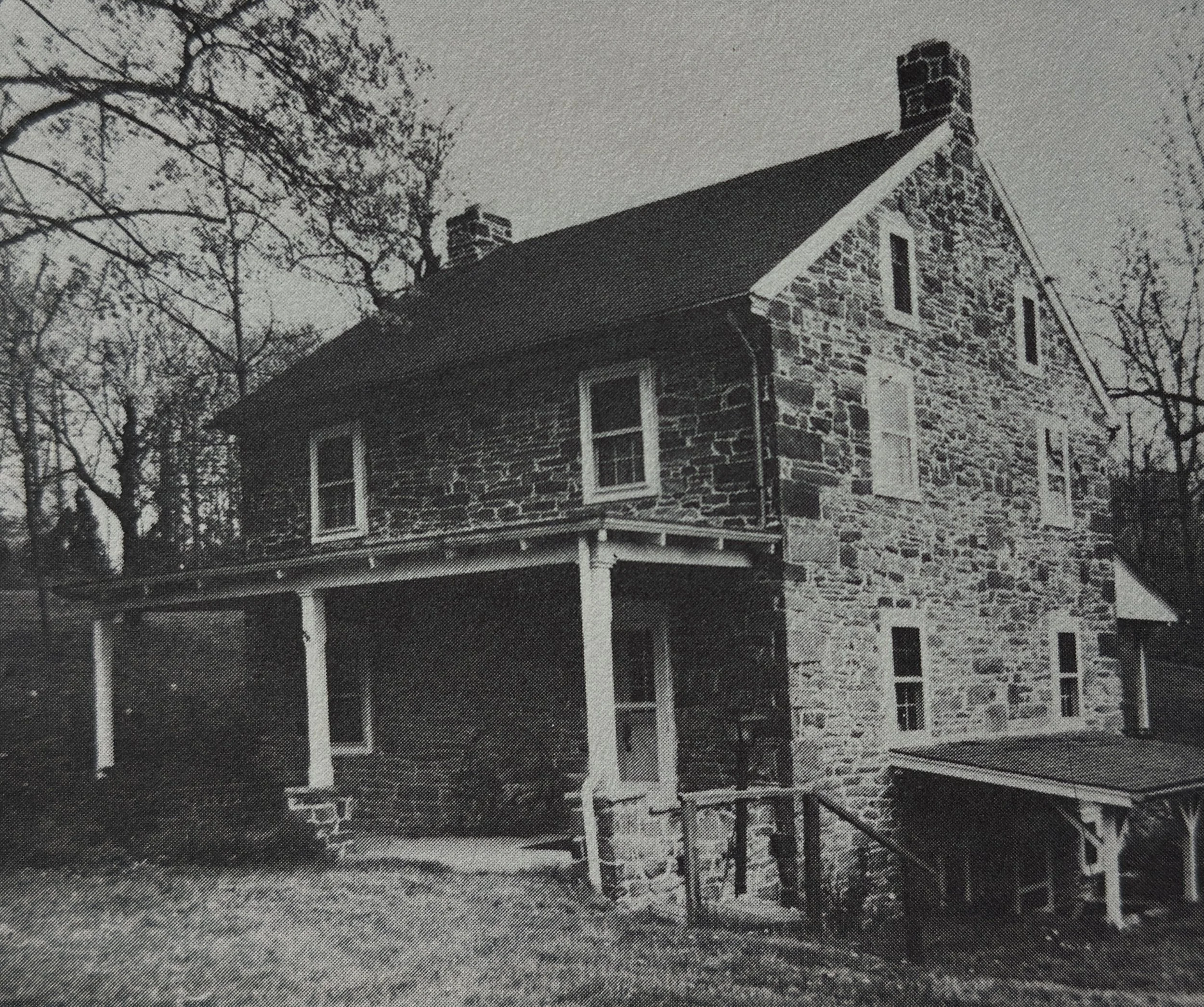
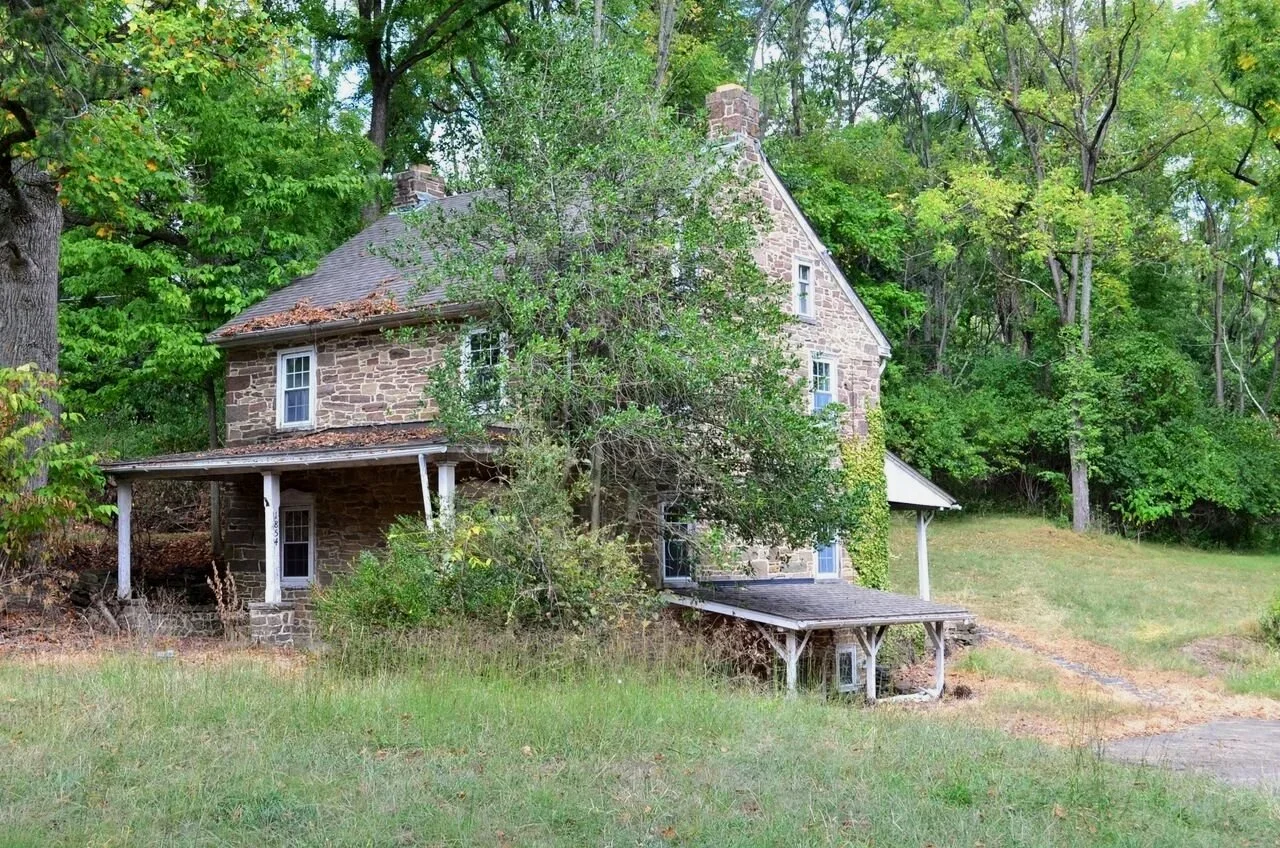
“This small brownstone home snuggles into the hillside at a sharp tum of Whitehall Road just after it leaves Skippack Pike. Many people in the area recall it as being the Huber home, very near to the Huber Quarry entrance, and so it was for over 50 years, but we can go back to a record dated November 26, 1746 where there is an account of a default of mortgage payment of L242, 65 shillings by Jean Christie for this "Plantation in Worchester Township and County of Philadelphia." The date on the record, November 26, 1746, was followed by these words: "Thirtieth year of the reign of our Sovereign, Lord George, the second, King of Great Britain." This was the land that John Christie had bought from Isaac Norris, and deeds mention that a house was already there.
At a sheriff sale, in 1765, the house, buildings and 92 acres were sold to Joseph and Mary McCrea for L 125, gold and silver. Their neighbors at this time were John Tyson, Benjamin Weber, Garret Bean, and John Dickenson (in tenure of Adam Bean).
McCrea owned the homestead for a long time, all the days of the Revolution and for many years afterward. During this time he sold off the lower, or southeast, side of his estate. In 1795, when he had become an old man, he sold the dwelling and 92 acres for L920, showing an excellent improvement for those days.
Thirty years later, and for the second time in the history of the farm, the mortgage payments could not be met. Adam Homsher, who had bought the property from Joseph McCrea in 1795, had to relinquish the farm to the assignees, Evan Jones and Rev. George Wack, the Reformed Preacher who lived near Custer Station.
Jesse Stern bought the farm in 1825, and for the third time misfortune came to its owner. After Jesse Stern had lived there more than 45 years, he was declared to be insane by the Montgomery County Courts. Jesse's wife, who had died some time before, left nine children: Sarah Ann, wife of John Batraff;
Obed, Abel, Levi, Catherine, wife of George Sheaff, Hannah, Eliza, John, George and Jesse, Jr. Once more the personal estate was insufficient to pay the debts of jesse Stern and support the children, and so the farm was sold at public auction on September 17, 1868
The farm, now reduced to 68 acres, was sold to Jesse and Margaret Frantz, and in 1876 was sold again by Frantz to Samuel Frantz for $8,000. A fourth time the owner of the property had trouble, and in 1900 it was bought from the sheriff by George and Mary Ann Huber. Here it remained in the Huber family for 53 years until it was purchased by James Glasgow in 1953.
This very early house which is beautifully built with its dovetailed cornerstones has several fireplaces, many-paned windows, and woodwork of an early period. Through the cellar flows a stream of cool spring water exiting under the foundation to an outside stream.
Mr. and Mrs. Charles Watkins reside here. Mrs. Watkins is the daughter of Mrs. James Glasgow.”
“Worcester”, 533-535
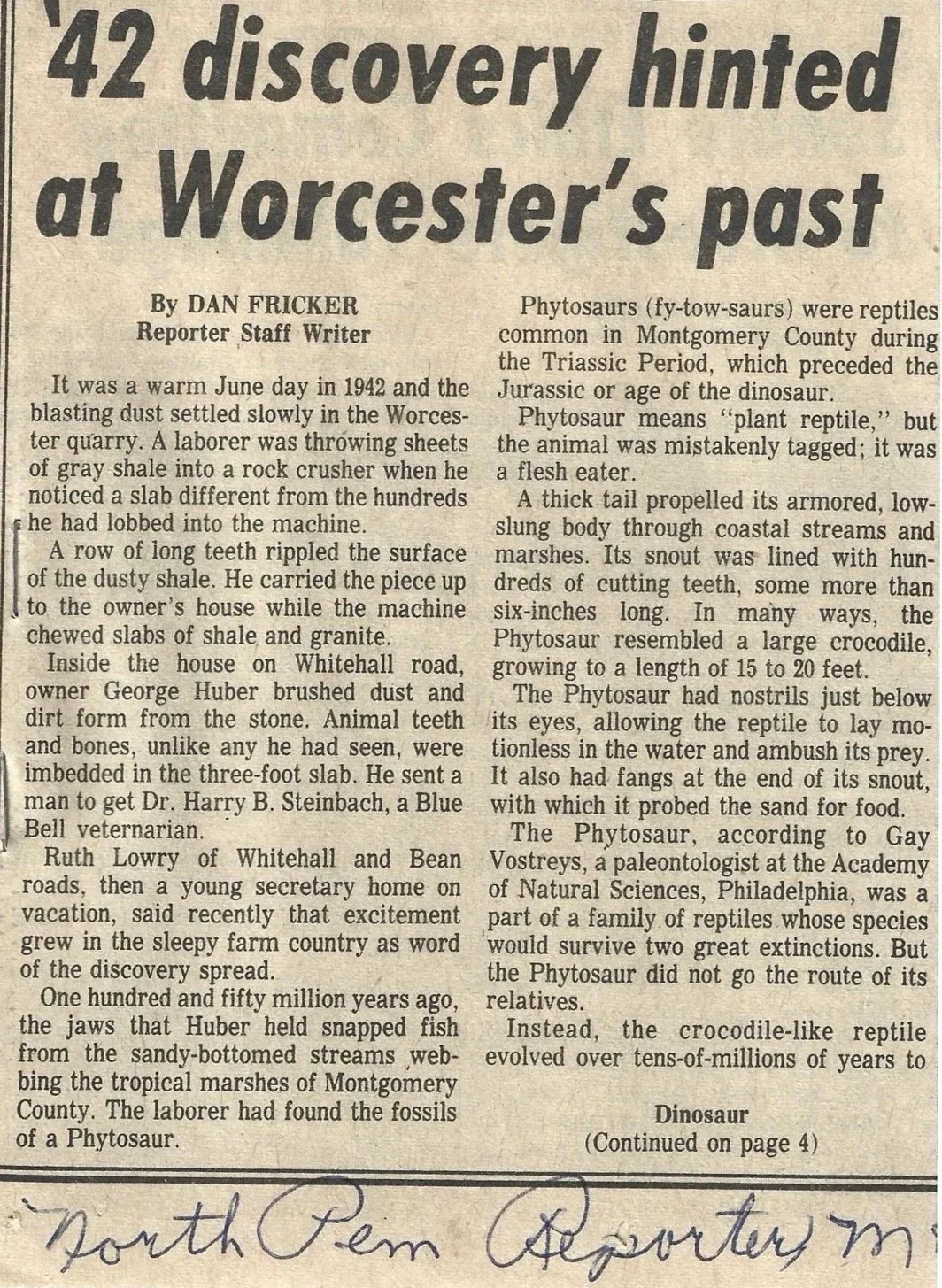
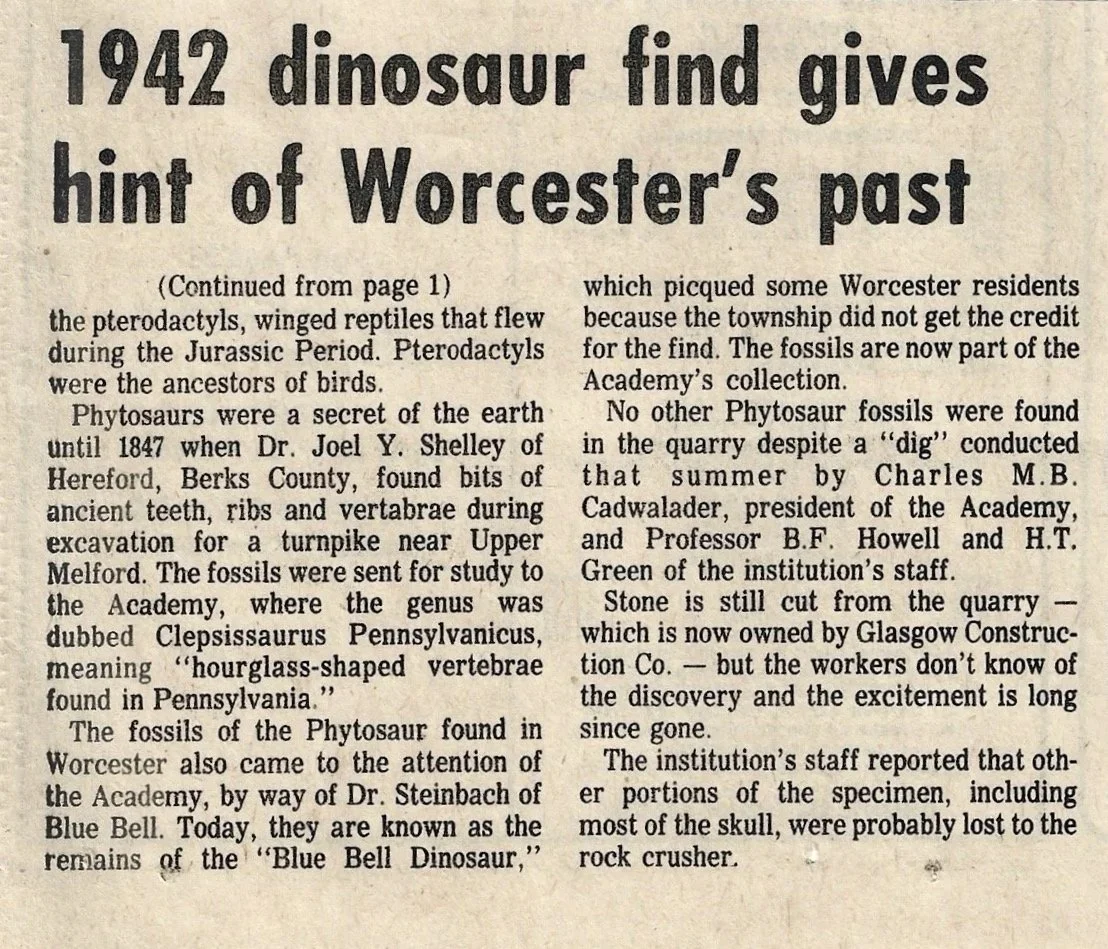
This then led to the discovery that in the 1940’s there was a dinosaur fossil found on the property along with several footprints.
The Clepsysaurus Fossil
'“In the Triassic Period, 200 million years ago, Pennsylvania was a different type of land. It was flat and tropical, through which shallow streams meandered to the ancient sea. Primitive plants densely covered the earth. This was the Age of Reptiles and existed long before the great landmass began the slow breakup into the continents we know today.
Ancient reptiles called Phytosaurus that preceded the dinosaurs by many million years, lived in these shallow rivers of North America and Europe during this period of earth's history. They varied in length from ten to twenty feet with nostrils on top of their heads, thus enabling them to glide in the water un-noticed. Their tail was heavy and strong and used to kill its prey. The end of the Triassic period was the end of the Phytosaurus.
The first fossil of this type of reptile was uncovered near Hassacs Creek in Upper Milford Township, Lehigh County, Pennsylvania by Dr. Shelly in 1852.
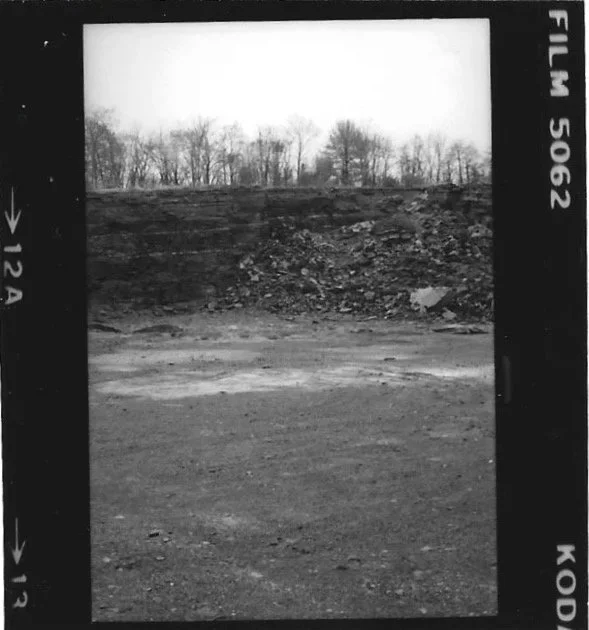
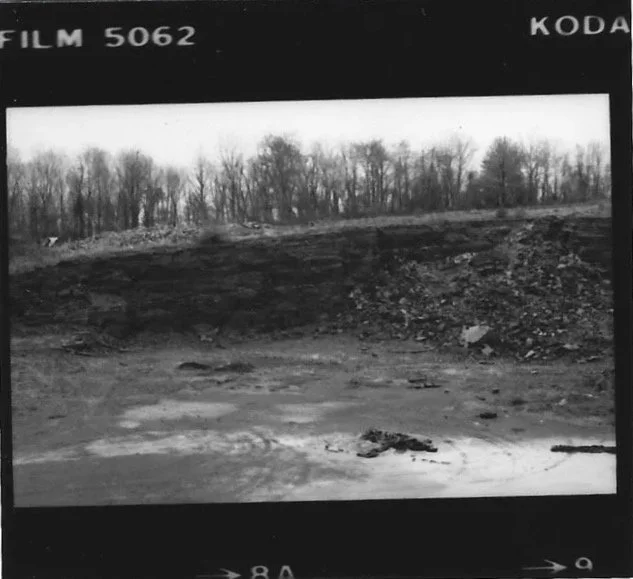
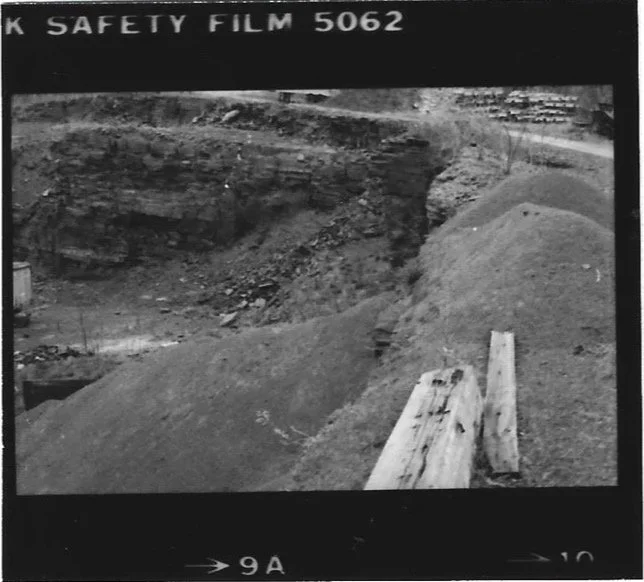
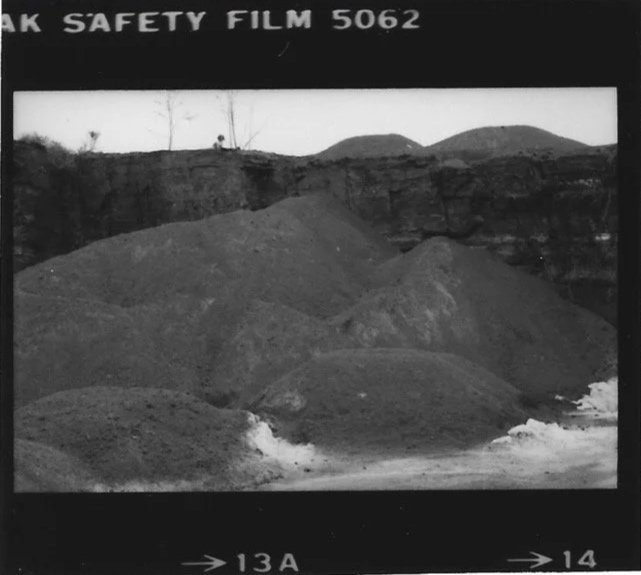
Ninety years later, a like type was discovered in Worcester Township. In June 1942, a workman plying a slab of stone out of its resting place in a stone quarry on the property of George Huber, near Skippack Pike and Whitehall Road, realized the unusual appearance of the slab. After much discussion, the slab was removed to the Huber Home.
Dr. Harry B. Steinbach, a veterinarian living in Blue Bell was contacted, and he immediately realized some type of fossil was embedded in the stone. Mr.
Charles M. B. Cadwalder, president of the Academy of Natural Sciences, Philadelphia, was told of the fossil. Mr. Cadwalder soon organized an expedition to investigate the find. The expedition went to the quarry, and the specimen was examined. A considerable amount of time was spent in an attempt to find more of the fossil, but to no avail.
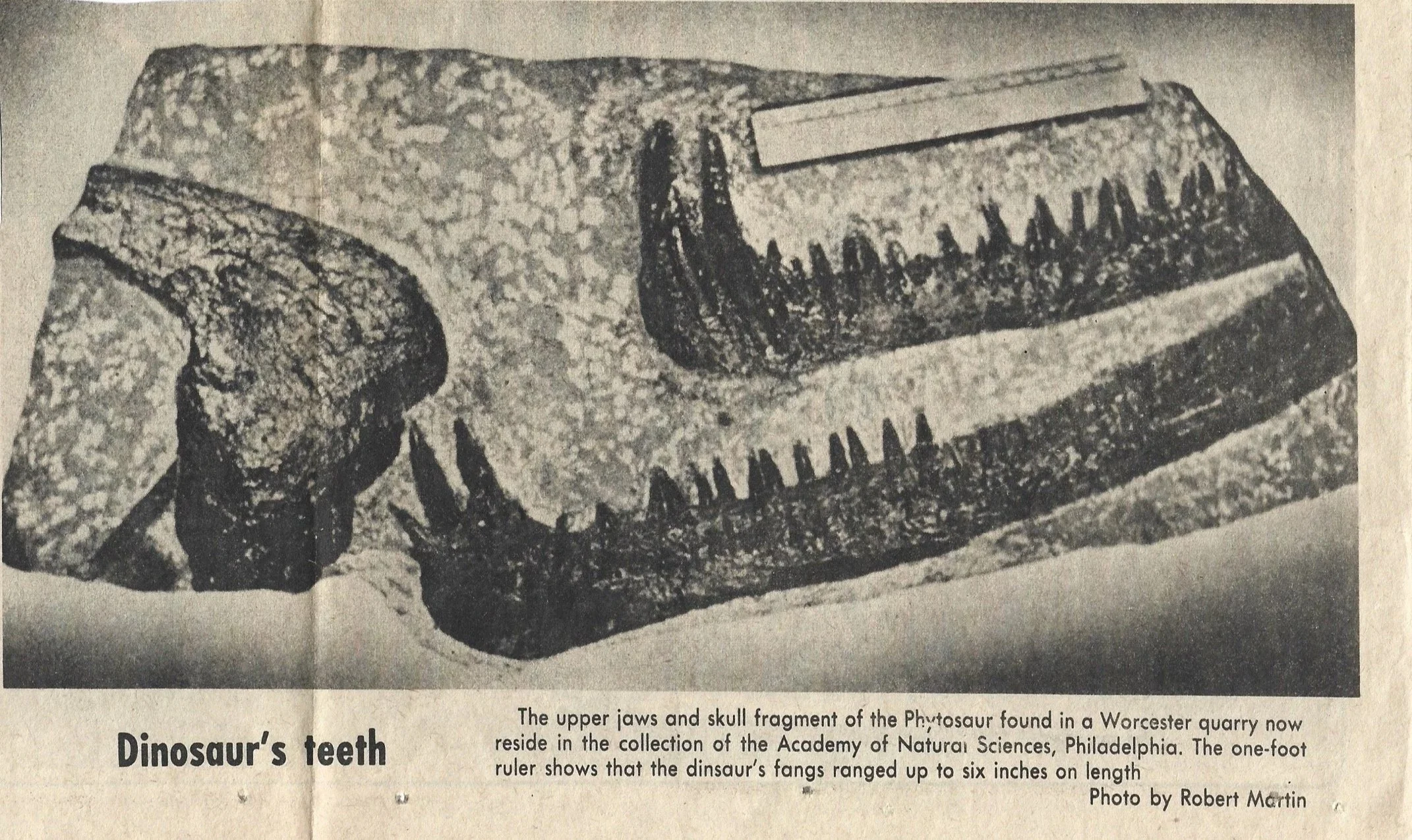
The heavy piece of rock, with a fossil exposed on one side, was sent to the Academy where the excess rock was chiseled away, and a pair of long reptilian jaws with sharp cruel teeth was exposed. These were the jaws of an animal known as Clepsysaurus, a member of the ancient reptiles, Phytosaurus. The halves of its lower jaw were so well-preserved in the block of shale that the Paleonthologist was able to read and relate the story. A fragment of the skull is close to the jaws.
The slab measuring three feet in length is stored in the archives of the Academy of Natural Science in Philadelphia, and the card at the Academy bears the date, June 18, 1942
The author of this article lives on Whitehall Road in Worcester Township and has a vivid recollection of this happening.”
“Worcester”, 274-275
1976-
2017-
2023-
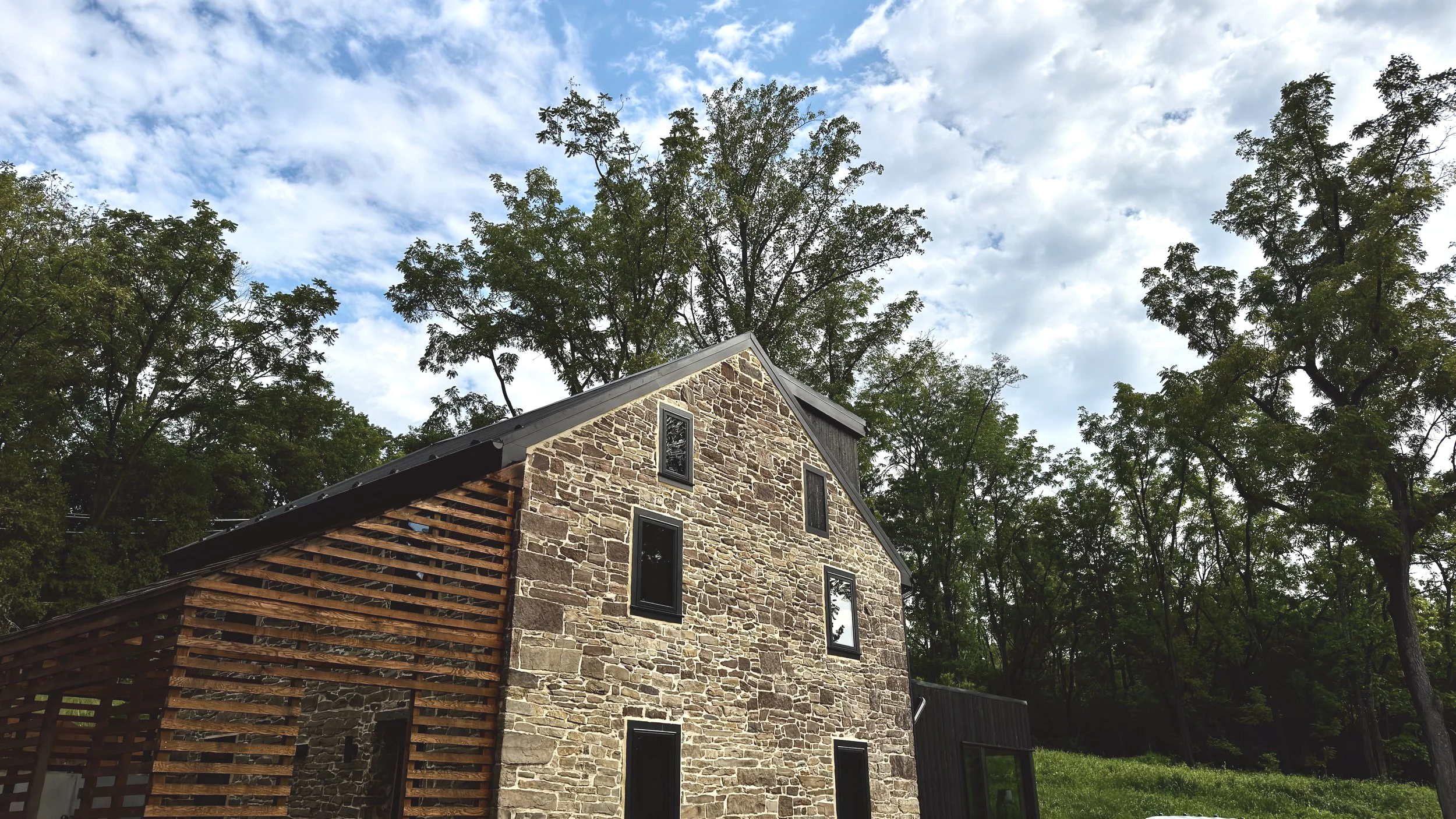
2026-